


Origins of Dow Theory
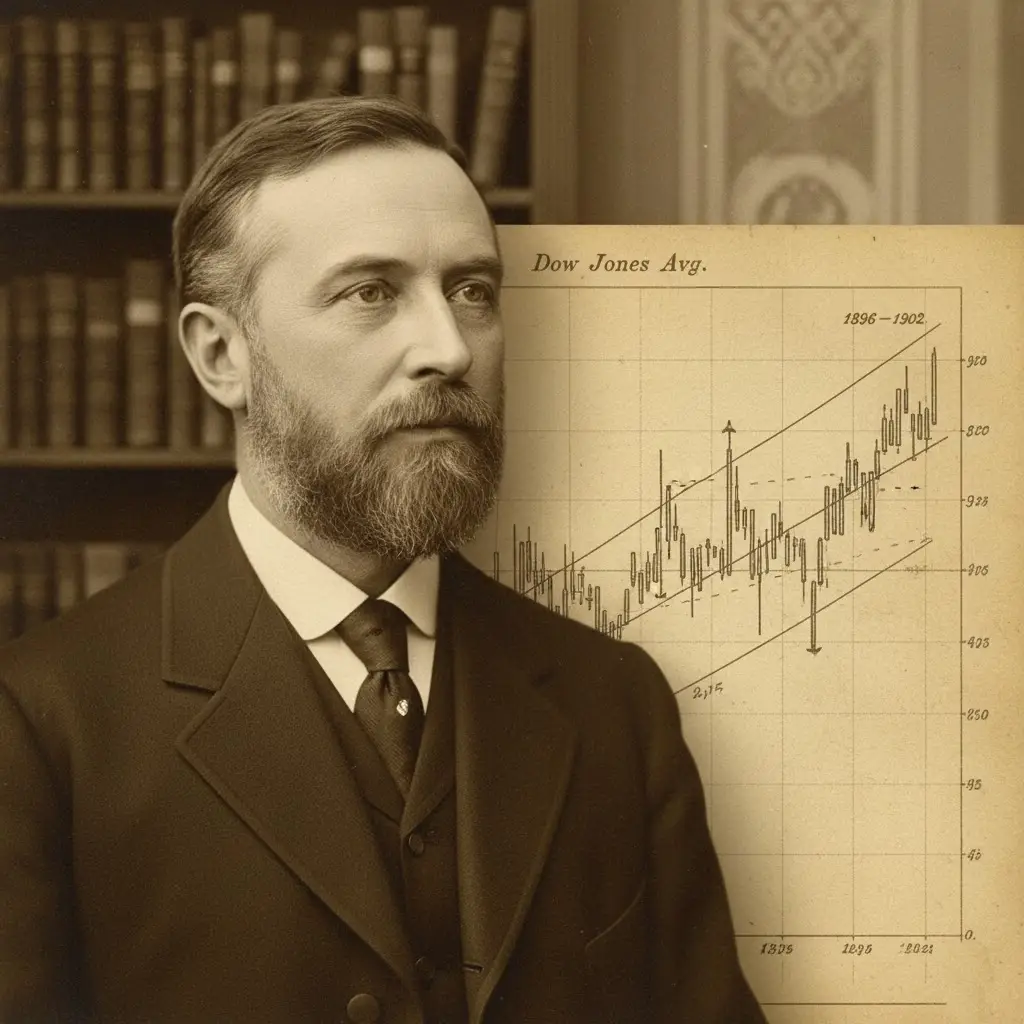
The Dow Theory was developed in the late 19th century by Charles H. Dow, co-founder of The Wall Street Journal and creator of the Dow Jones Industrial Average.
His purpose was not to predict markets but to understand how trends form and evolve through the interaction of price, volume, and investor psychology.
The three types of trends
Dow described three simultaneous types of trends:
- Primary trend: long-term movement lasting months or years.
- Secondary trend: corrections or retracements within the main trend.
- Minor trend: short-term fluctuations lasting days or hours.
A trader must understand that what seems bullish on the 1-hour chart might simply be a correction inside a daily downtrend.

The three phases of a market cycle
Each major trend develops in three phases:
- Accumulation: professionals buy while the crowd is pessimistic.
- Public participation: the trend becomes obvious; volume rises.
- Distribution: institutions begin to sell as retail traders keep buying.

This behavioral cycle repeats across all markets stocks, Forex, and crypto alike.
Volume and confirmation
Dow stated that volume must confirm price direction.
Rising prices with increasing volume indicate strength, while a price rise with falling volume suggests exhaustion.
Volume should expand during impulses and contract during corrections a timeless principle still used today with tools like Volume Profile and On-Balance Volume (OBV).

Market structure and trend changes
According to Dow, an uptrend consists of higher highs and higher lows, while a downtrend shows lower highs and lower lows.
A change in structure occurs when that pattern breaks for instance, when price forms a lower low in an uptrend.
This idea evolved into modern Smart Money Concepts (SMC), which integrate liquidity and order flow.

Limitations and modern application
Dow Theory is a conceptual framework, not a fixed trading system.
Its main limitations:
- No precise entry or exit signals.
- Slower confirmation compared to modern indicators.
- Daily closes can be ambiguous in 24-hour markets like Forex or crypto.
Nevertheless, Dow’s principles remain the foundation of technical analysis and are especially valuable for prop traders, who must understand the larger market context behind every move.
