



In this lesson, we’ll explore how to create and manage your trading plan from its essential components to how to maintain and refine your strategies as markets evolve. The goal is to guide you step by step, as if a professional mentor were walking you through the process.
What Is a Trading Plan and Why Is It Essential?
A trading plan is your personalized roadmap in the financial markets a document that defines what, how, and when to trade, tailored to your goals and personality.
Why is it so crucial? Imagine sailing a ship in open waters without a compass or map that’s trading without a plan. A trading plan keeps you focused, objective, and disciplined, especially during volatile market conditions. It helps you make data-based decisions rather than emotional ones.
In short, a trading plan is your protection against impulsive actions. It prevents you from overtrading, chasing losses, or deviating from your strategy due to fear or excitement.
Professionals always say: “Plan your trade, and trade your plan.”
Having a written plan means you always know what to look for, how much to risk, and how to react under specific circumstances all of which give you a clear structure and consistency.

The Key Components of an Effective Trading Plan
There’s no single plan that fits everyone your plan must be built for you. Still, every solid trading plan should contain certain universal elements. Let’s go through them:
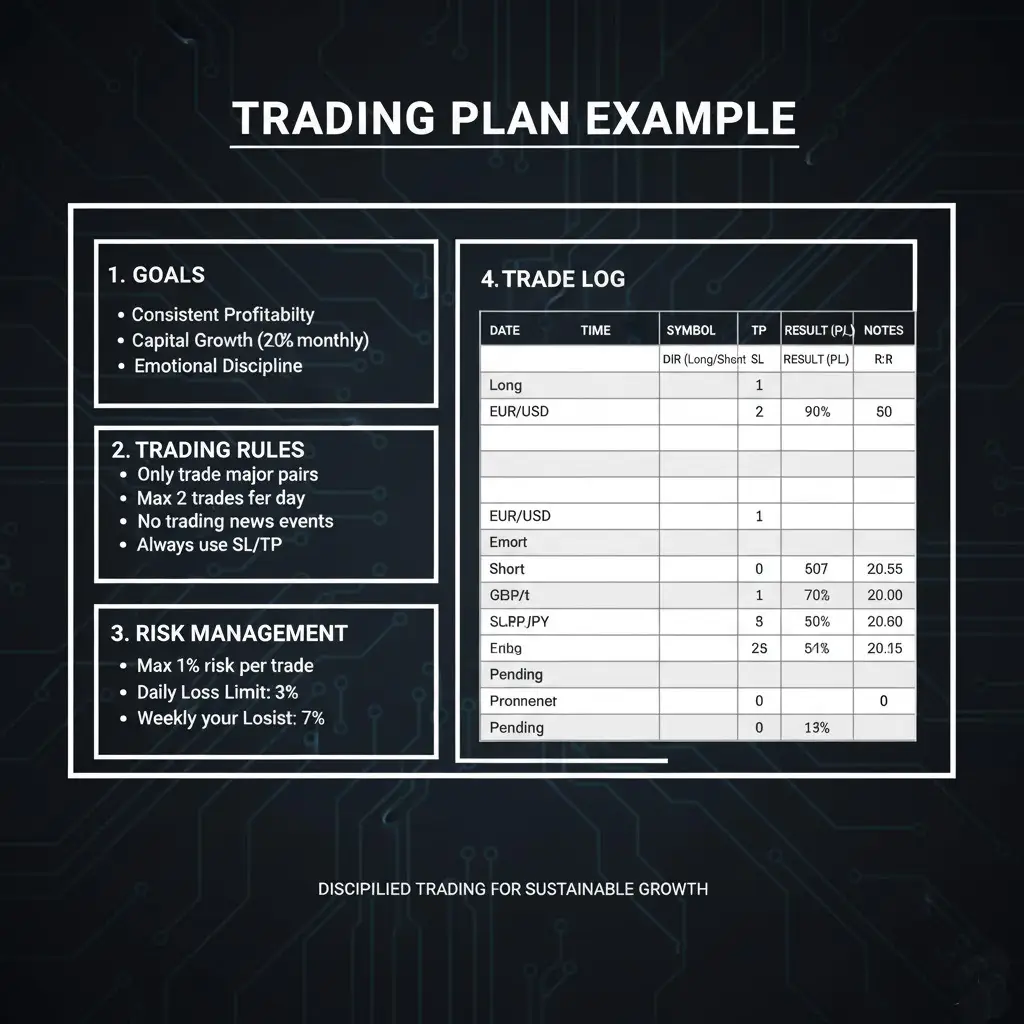
- Clear goals and objectives: Define what you want to achieve. Are you seeking steady monthly income, long-term growth, or simply experience? Be specific: “Achieve 5% annual growth,” or “Reach 100 pips per month.” Goals give direction and measurable progress.
- Risk profile and capital: Define how much you’re willing to risk. This includes your risk tolerance (the % of capital risked per trade) and your total account size. A common rule is to risk no more than 1–2% per trade. For example, on a $10,000 account, risk $100–$200 per trade. This keeps you safe during losing streaks. Remember: never risk money you can’t afford to lose.
- Markets and instruments: Specify what you’ll trade forex, stocks, crypto, futures and which instruments (e.g., EUR/USD, S&P 500, gold). Also note your timeframe (day trading, swing trading, long-term). Clarity prevents distraction and overexposure.
- Trading strategy (entry and exit rules): Describe how you’ll find opportunities and execute trades. Include your setup type (trend-following, breakout, reversal, etc.), entry criteria, exit criteria, and risk/reward requirements. For example:
“Buy when the 50 EMA crosses above the 200 EMA and RSI is below 70; stop loss below last swing low; target next resistance.”
The more specific your rules are, the easier it is to follow them objectively. - Risk and money management: Detail how you’ll size positions and manage losses. Define maximum daily or weekly drawdown limits (e.g., “If I lose 3% in a day, I stop trading”). Include your minimum acceptable risk/reward ratio (e.g., at least 1:2 or 1:3).
- Trading schedule: Define when you trade. Maybe only during the London session, or two hours before New York open. Structure builds discipline and prevents burnout. Example:
“I trade from 9:30–11:30 AM NY time and avoid high-impact news releases.” - Mental and technical preparation: Prepare both your tools and your mindset. Before trading, check your platform, connection, and charts and check yourself: are you calm, focused, and rested? A simple pre-trading ritual like 5 minutes of breathing can make a huge difference.
- Trading journal and review: Plan how you’ll record and analyze your trades. Define what data to log (entry, exit, reason, emotion) and when to review it. Your plan should note that it’s a living document updated as you grow and markets evolve.
Designing and Validating a Strategy Practically
Having a plan is great, but you need a tested strategy to fill it. Designing a trading strategy means creating a specific set of entry/exit rules that give you a statistical edge and validating that they actually work.
Here’s how to do it step by step:
1. Design the strategy
Start with an idea based on logic or observation for example, price tends to bounce from daily support levels. Write down precise rules:
“Buy when the 50 EMA crosses the 200 EMA and price is above VWAP. Place stop loss 20 pips below entry, take profit at 2× risk.”
2. Backtesting
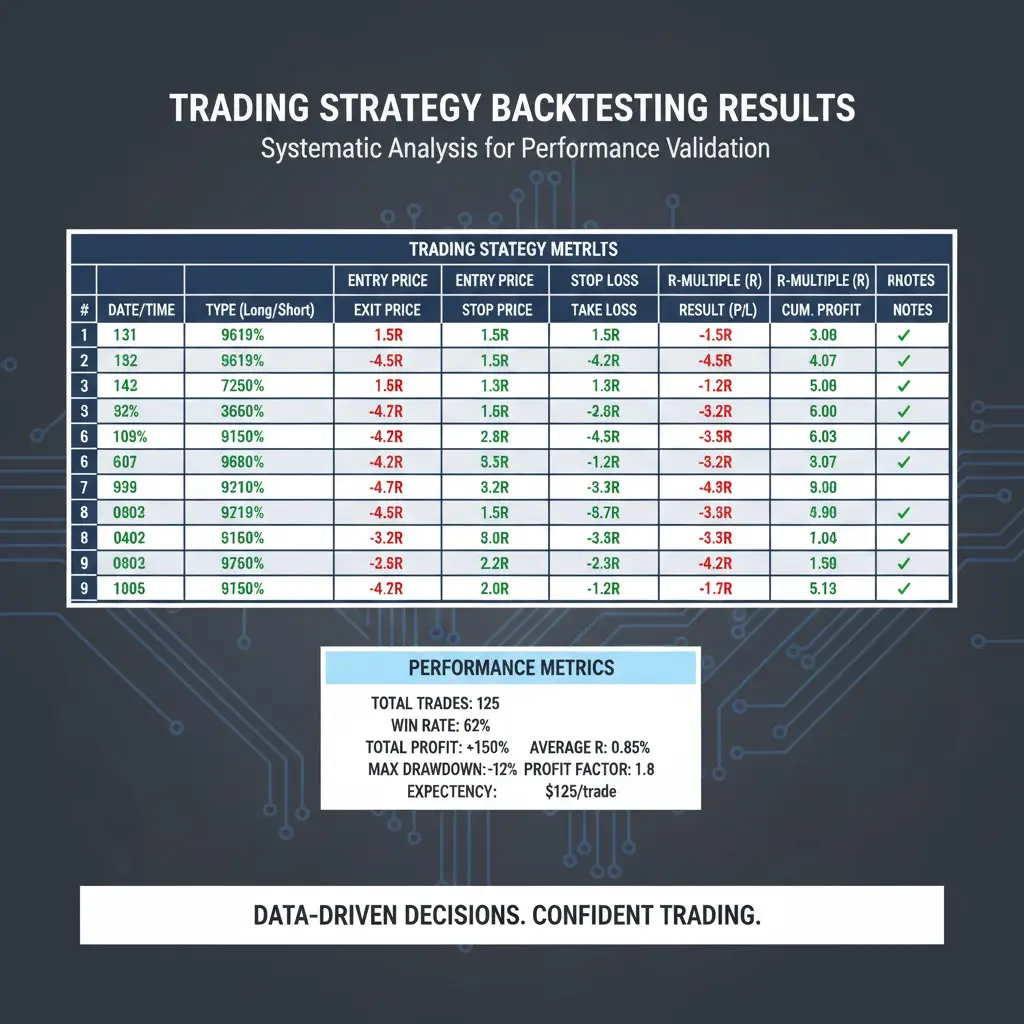
Test your rules on historical data manually or with software. Review how they would have performed: win rate, average win/loss, drawdown. If the system loses consistently, you’ll find out early without losing real money.
3. Optimization and refinement
Adjust the strategy if needed. Maybe it works better on certain pairs, timeframes, or volatility conditions. Avoid overfitting don’t tweak endlessly just to make past results perfect. Simplicity beats complexity.
4. Forward testing (demo trading)
Run the strategy live on a demo account for several weeks. This shows if it holds up in real market conditions and tests your discipline to follow it exactly. Many strategies look great on paper but fail in live execution demo trading bridges that gap.
5. Gradual implementation
If demo results are consistent, start trading small amounts of real capital. Keep risk minimal at first. The goal is to confirm that both the system and your emotions perform well under real conditions.
6. Continuous review
Even good strategies can stop working. Periodically review performance metrics. If a strategy’s win rate or expectancy drops significantly, pause it, re-evaluate, or adapt it to new market behavior.
The Trader’s Daily Routine and Operational Planning
Success in trading isn’t only about strategy it’s about daily discipline. Having a consistent pre-market, during-market, and post-market routine builds stability and confidence.
Pre-market routine: prepare like a professional
Start your day like an athlete before competition:
- Check the news: Review the day’s economic events (interest rate decisions, employment data, etc.) to understand the day’s context.
- Analyze key levels: Mark supports, resistances, and possible trade zones.
- Verify tools: Test your platform, data feed, and alerts. Nothing ruins a trade like a technical issue.
- Prepare mentally: Ask yourself am I calm, focused, and ready? If not, it’s okay to skip trading that day.

During the session: execution with discipline
Follow your checklist before every trade:
- Does it match my strategy rules?
- Is there any conflicting news event?
- Have I calculated position size and placed stop loss?
Avoid improvising. Stick to your pre-session analysis. Let the market come to you instead of chasing it.
Post-session: review and reset
At the end of your trading day, close positions per your rules, save chart screenshots, and jot down notes like:
“+1.5% today, but entered one setup too early need to be more patient.”
This process helps you release tension and ensures that every day adds to your learning curve.

The Role of a Trading Journal
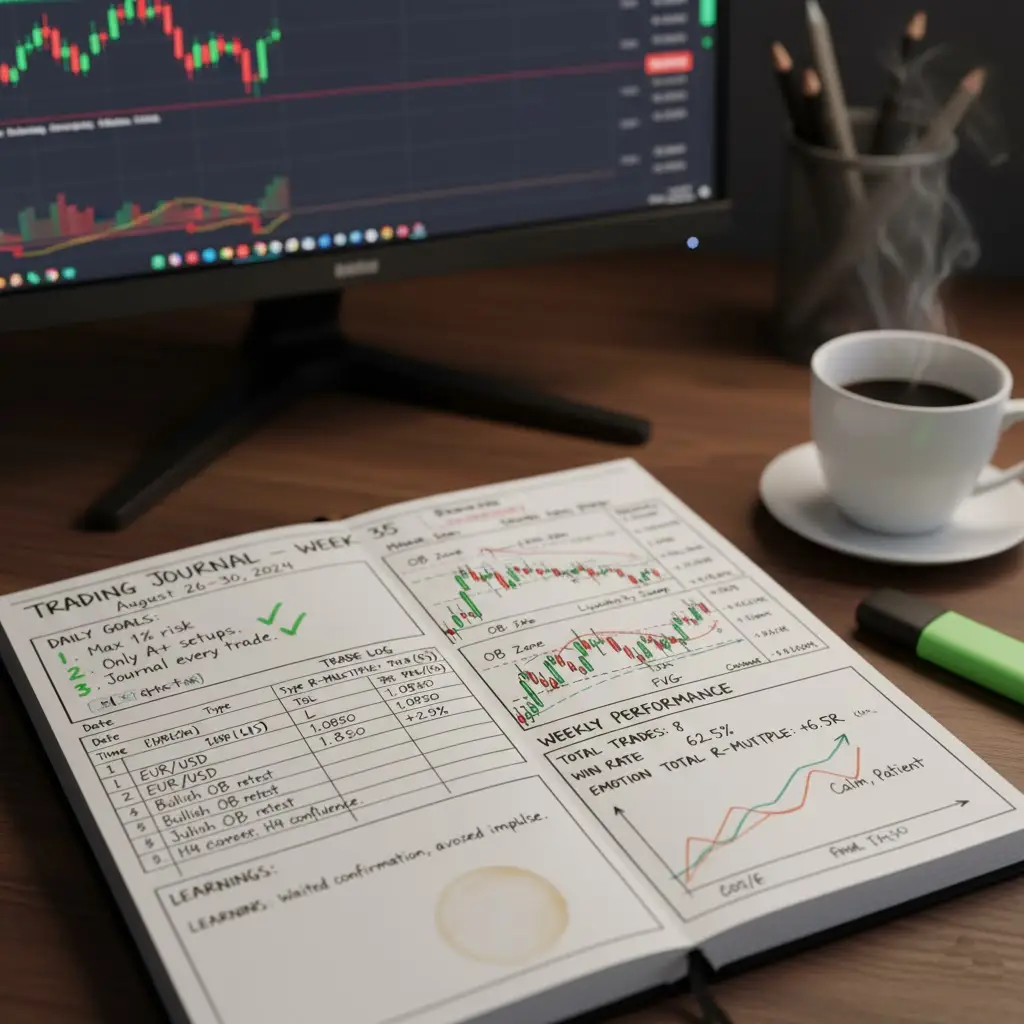
Your trading journal is your most powerful learning tool. It’s more than a list of trades it’s a mirror reflecting your decisions, emotions, and progress.
Record for each trade:
- Date and time
- Instrument
- Entry and exit price
- Position size
- Result (in pips, $, or %)
- Reason for entry
- Emotions or thoughts during the trade
- Post-trade reflections
Attach chart screenshots if possible.
Why it matters
The journal transforms random experiences into concrete lessons. By reviewing it weekly or monthly, you’ll spot patterns both technical and emotional.
You might realize: “Every time I trade against the trend, I lose,” or “I cut winners too early out of fear.”
It also builds emotional awareness: during losing streaks, reading your journal can remind you that you’ve recovered before or help identify exactly what changed.
Tips for effective journaling
- Be honest: Record everything, even mistakes.
- Be consistent: Log trades daily.
- Analyze periodically: Summarize stats like win rate, average risk/reward, best/worst days.
- Learn and adjust: Use the data to refine your plan.
Diversification and Market Adaptation
Markets constantly evolve. What worked last year might not work tomorrow. That’s why professionals practice strategy diversification and adaptability.
Diversify your strategies
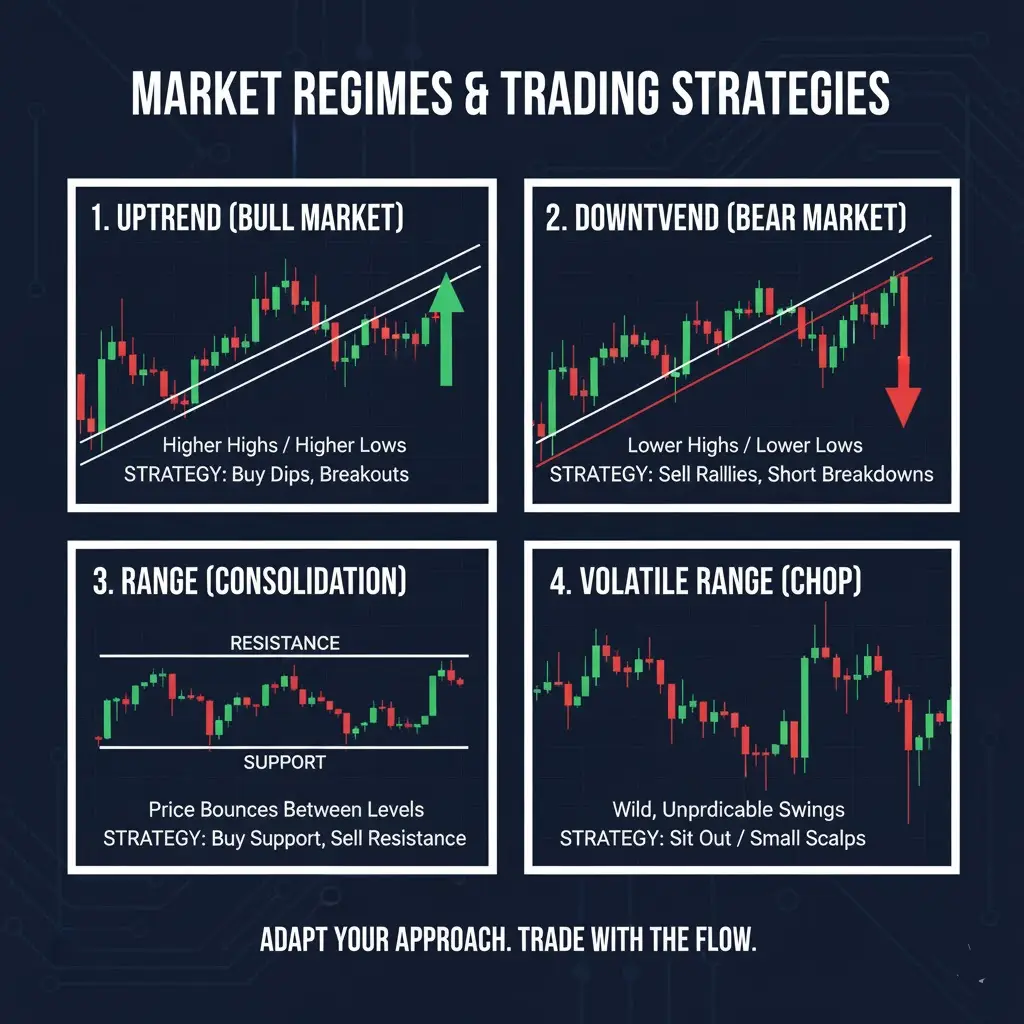
Relying on one single strategy is risky. A trend strategy thrives in strong moves, but fails in sideways markets. Having 2–3 strategies for different conditions ensures you can stay profitable across environments.
Example portfolio:
- Momentum or breakout strategy for high-volatility markets.
- Range strategy for consolidation phases.
- News-following or volatility fade strategy for fundamental events.
Diversification smooths performance if one system underperforms, another can offset it.
Adapt to changing markets
Adaptation doesn’t mean constantly changing everything; it means adjusting intelligently when the market’s behavior changes.
You might:
- Tighten or widen stops during volatile periods.
- Pause certain setups when conditions no longer fit.
- Lower position size during uncertainty.
Successful traders know when to stand aside. Sometimes, the best trade is no trade waiting for your strategy’s ideal conditions.
Periodic Evaluation and Continuous Improvement
A trading plan is a living system you must review and refine it regularly.
Schedule time weekly or monthly to:
- Review trading statistics (win rate, R/R ratio, profit factor, drawdown).
- Evaluate discipline: did you follow the plan?
- Note emotional patterns were you overconfident, fearful, or tired?
The goal isn’t to criticize yourself but to optimize performance. After each review, write actionable improvements such as:
- “Stop trading after 3 consecutive losses.”
- “Reduce screen time to avoid fatigue.”
- “Only take trades that meet all checklist criteria.”
Continuous improvement may also mean simplifying removing what doesn’t help. Sometimes less is more.
Finally, celebrate your progress. Recognize milestones, even small ones. This keeps motivation high and reinforces good habits.